Task management covers everything that takes a task from its first description to completion: planning, assigning, prioritizing, tracking and reviewing. This guide defines the term, gives five practical tips, compares five prioritization methods from SMART to time blocking and lists the criteria for choosing task management software.
What is task management?
Task management is the planning, organizing, execution and control of tasks. It covers the whole life cycle of a task: from writing it down, through assigning it to a person, to accepting the result.
Task management can be part of project management. There it coordinates the work of several people or teams toward a shared project goal. It can also serve self-organization alone, for example as a personal to-do list.
How does task management differ from project management?
Task management steers individual tasks; project management steers the whole undertaking. A task has one responsible person, a due date and a status. A project links many tasks through dependencies, resources, budget and milestones into a plan with a start and an end.
Every task carries these attributes:
- Status
- Due date
- Responsible person (resource)
- Effort and budget
- Priority
- Recurrence and notifications
5 tips for effective task management

1. Controlling: Check regularly how work is progressing and review interim and final results. This lets you correct course early. The lesson Project Controlling shows how this works in a project.
2. Reminders: Automatic notifications and status displays keep deadlines visible, even when you run many tasks in parallel.
3. Minimize follow-up questions: Add everything the task needs to its description: attachments, due date, next steps. Ideally, the person doing the work finds everything in one place. Track the status in more detail than just "open" and "done".
4. Share know-how: A project succeeds only if every team member has their tasks under control, not just the project manager. Share methods and ways of working in the team, for example in a short training session.
5. Plan a buffer: Plan realistic time frames and a buffer for the unexpected. Estimates for single tasks often turn out too tight; a three-point estimate makes the uncertainty visible.
Which methods help you prioritize tasks?
Five methods cover most situations. Each answers a different question: Is the task clearly defined? What comes first? What belongs in scope at all? When do I work on it?
| Method | Key question | Use |
|---|---|---|
| SMART goals | Is the task specific, measurable, achievable, relevant and time-bound? | Writing tasks and goals |
| Eisenhower matrix | How important and how urgent is the task? | Daily planning, delegating |
| MoSCoW method | Must, should, could or won't? | Setting scope, cutting under time pressure |
| ABC analysis | How much does the task contribute to the goal? | Few A tasks first, batch C tasks |
| Time blocking | When in my calendar do I do the task? | Planning focused work blocks |
ABC analysis sorts tasks into three classes by their contribution to the goal. A tasks are few but deliver most of the result; do them first. B tasks get a fixed slot. C tasks are numerous and contribute little; batch or delegate them. If you weigh projects rather than tasks against each other, use a four-quadrant matrix of value and effort.
How do you choose task management software?
The range of free and paid to-do apps and task management tools is huge. Some run in the cloud, others locally on your computer. Three questions narrow the choice.
Is a to-do list enough, or do you need project planning?
Free apps usually offer lists only. For tasks inside a project that is rarely enough: tasks depend on each other and need resources, budget and a sequence in time. Views such as a Gantt chart, a Kanban board or a mind map make these relationships visible. The fewer applications you combine, the less data you have to keep in sync.
Web application or local application?
| Criterion | Web application (SaaS) | Local application |
|---|---|---|
| Access | From any device with internet, depends on the connection | Local, internet not required |
| Offline | Only with a built-in offline mode | By default |
| Customization | Often limited | Usually extensive |
| Updates | Automatic | Controlled by the user |
| Data storage | With the provider | With the user, full control |
| Collaboration | Built in | Through a server or sync extension |
If you work with sensitive data, data storage weighs most. Local applications keep data on your own devices; for team work, server or sync solutions add access on the go.
Does the tool fit your platform?
If you work on Mac, iPad and iPhone, check whether there is a native app for all three and whether data syncs between them. A browser interface on the iPad handles differently from an app built for touch and Apple Pencil.
Task management in Merlin Project
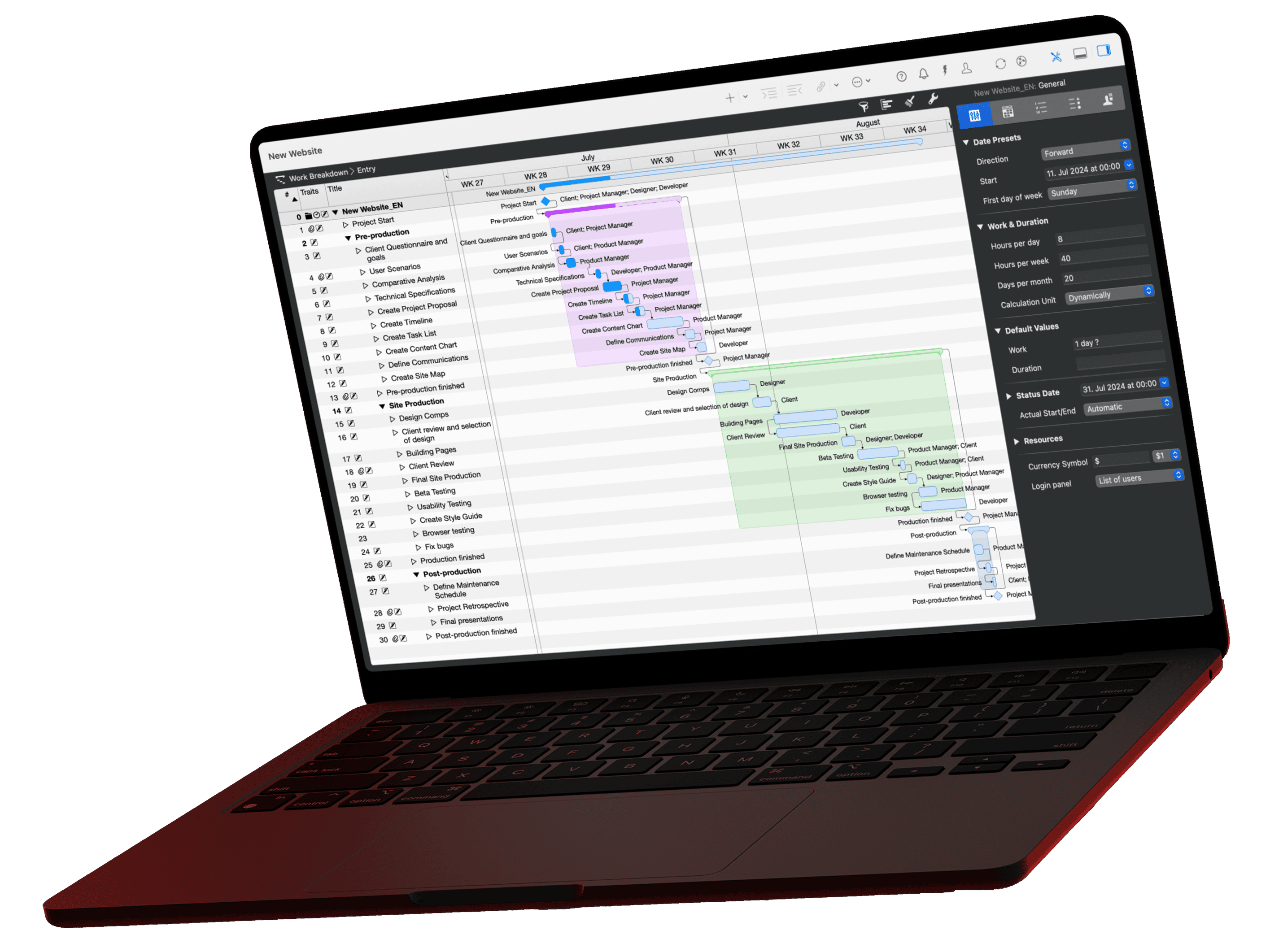
Merlin Project treats tasks as activities in the project plan. The same activities appear in the Gantt chart, on the Kanban board and in the mind map. Move a card on the Kanban board to the "Done" column, and the activity shows 100 percent in the Gantt chart as well.
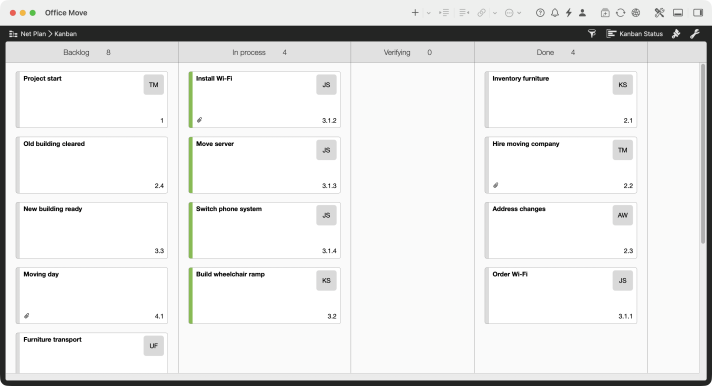
Kanban board for the office move
View › Net Plan › Kanban shows the activities as cards. Each column carries a progress value, for example Verifying with 80 percent. The lesson Task Management in Merlin Project shows how to set up the board, set priorities and filter due tasks.
For plain to-do lists without a project, Merlin Project is more than you need. Its strength shows where tasks depend on each other and dates, resources and costs are planned together.
Conclusion
Task management starts with clearly written tasks and ends with a check of the result. Prioritize with a method that fits the question, plan a buffer, and choose a tool that shows tasks in the context of the project when your tasks depend on each other.
This article was last updated on October 22, 2026.
If you have any questions about this blog article or would like to discuss it, we look forward to your contribution in our forum.
Frequently asked questions
What is task management?
Task management is the planning, organizing, execution and control of tasks. It takes a task from its description through assignment to the acceptance of the result, in a project or for personal organization.
What is the difference between task management and project management?
Task management steers individual tasks with an owner, a due date and a status. Project management links many tasks through dependencies, resources, budget and milestones into a plan with a start and an end.
Which methods help prioritize tasks?
Common methods are SMART goals for writing tasks, the Eisenhower matrix for importance and urgency, the MoSCoW method for scope, ABC analysis for contribution to the goal, and time blocking for calendar planning.
Is a free to-do app enough for team task management?
For independent single tasks, often yes. When tasks depend on each other and need resources, budget and a sequence in time, a plain list lacks the planning logic. Then project management software with a Gantt chart and a Kanban board fits better.