Time and materials (T&M) is a contract model in which the client pays the hours actually worked at fixed hourly rates plus materials; under a fixed price, the client pays a total agreed in advance. The PMBOK Guide adds cost-reimbursable contracts such as CPFF, CPIF and CPAF. The contract type decides who pays when a project needs 20% more effort.
This article compares the common contract types, works through time and materials versus fixed price on one project and shows how to control budget, hourly rates and actual costs in Merlin Project.
What Is a Time and Materials (T&M) Contract?
A time and materials (T&M) contract is an agreement in which the client pays every hour worked at the agreed hourly rate and materials at actual cost. The total price is only known at the end.
The US Federal Acquisition Regulation defines the hourly rate as a fixed rate that includes wages, overhead, general and administrative expenses and profit (FAR 16.601). The contractor therefore earns on every hour. T&M fits when scope or duration can't be estimated reliably at the start, such as agile software development or consulting.
What Is a Fixed Price (Fixed Fee) Contract?
A fixed price contract (firm fixed price, FFP, often called fixed fee) is an agreement in which client and contractor set a total price for a defined scope in advance. If the work costs more, the contractor absorbs the difference; if it costs less, the contractor keeps it.
A fixed price requires a precise scope. Without a statement of work with exclusions and acceptance criteria, the parties argue over every change about whether it is included in the price. You handle scope changes through change requests.
What Is a Cost-Reimbursable Contract?
A cost-reimbursable contract is an agreement in which the client reimburses the contractor's actual costs and pays a fee on top. The PMBOK Guide distinguishes three variants; the US regulation FAR Part 16 defines them in detail:
- CPFF (cost plus fixed fee): The fee is set at contract award and does not vary with actual cost (FAR 16.306).
- CPIF (cost plus incentive fee): If costs come in below target, the fee rises up to a maximum; if they exceed it, the fee falls down to a minimum (FAR 16.405-1).
- CPAF (cost plus award fee): The contractor earns all or part of an award amount depending on how the client rates cost, schedule and technical performance (FAR 16.405-2).
Cost-reimbursable contracts appear where nobody knows the costs in advance: research, development, prototypes.
What Types of Contracts Are There in Project Management?
Project management uses three basic contract types: fixed price, time and materials and cost-reimbursable. The PMBOK Guide splits fixed price and cost-reimbursable into three variants each; time and materials sits between them as a hybrid. The table compares all eight forms, including T&M with a cap.
| Contract type | How it pays | Who carries the cost risk | Changes | Typical use |
|---|---|---|---|---|
| Firm fixed price (FFP) | One total price for the agreed scope | Contractor | Costly, only via change request | Clearly defined scope, e.g. software rollout per SOW |
| Fixed price incentive fee (FPIF) | Target cost, target profit, price ceiling and formula; profit falls as cost rises (FAR 16.403-1) | Mostly contractor, fully above the ceiling | Via change request | Large projects with a well estimated scope |
| Fixed price with economic price adjustment (FP-EPA) | Fixed price that moves up or down with agreed indexes or labor and material costs (FAR 16.203-1) | Contractor, price swings shared | Via change request | Multi-year contracts, construction with steel or energy price risk |
| Time and materials (T&M) | Hours times hourly rate plus materials | Client | Easy, scope stays flexible | Unclear scope, agile development, consulting |
| T&M with cap | Like T&M, up to an agreed maximum | Client up to the cap, contractor above it | Easy within the budget | Unclear scope with a fixed budget |
| Cost plus fixed fee (CPFF) | Reimbursed costs plus a fixed amount | Client | Easy | Research, development |
| Cost plus incentive fee (CPIF) | Reimbursed costs plus a fee that rises as costs fall below target | Mostly client, deviations shared | Easy | Development with a cost target |
| Cost plus award fee (CPAF) | Reimbursed costs plus an award based on a performance rating | Client | Easy | Work whose quality is hard to measure |
Who Carries the Risk in Each Contract Type?
Under a fixed price the contractor carries the cost risk, under cost-reimbursable contracts the client does; every other type splits it in between. The further right the orange share ends, the more of any overrun the client pays.
Risk spectrum of contract types
Who pays when the project costs more than planned?
CPFF Cost plus fixed fee
CPAF Cost plus award fee
T&M Time and materials
CPIF Cost plus incentive fee
T&M + cap Not-to-exceed
FP-EPA Economic price adjustment
FPIF Fixed price incentive fee
FFP Firm fixed price
Our own schematic ranking based on the payment mechanics in FAR Part 16; bar lengths show the order, not measured values.
Two points decide the position: whether the contractor's profit grows with cost (T&M, CPFF) and whether a ceiling exists above which the contractor pays (FPIF, T&M with cap, FFP).
Time and Materials vs Fixed Price: Which Costs Less?
Time and materials costs the client less as long as actual effort stays below the estimate plus the risk premium; above that, the fixed price is cheaper. The worked example shows the threshold on one project.
Example: An engineering firm rolls out a document management system. The IT contractor estimates 400 hours at €95, which is €38,000 on a time and materials basis. For a fixed price, it adds 15% for the quantity risk and quotes €43,700. A third option is T&M with a cap of €44,000. The risk premium is an assumption for this example; in practice it depends on how well the scope is defined.
| Actual effort | Time and materials | Fixed price | T&M with €44,000 cap |
|---|---|---|---|
| 340 h (15% below estimate) | €32,300 | €43,700 | €32,300 |
| 400 h (as estimated) | €38,000 | €43,700 | €38,000 |
| 460 h (15% above estimate) | €43,700 | €43,700 | €43,700 |
| 480 h (20% above estimate) | €45,600 | €43,700 | €44,000 |
| 560 h (40% above estimate) | €53,200 | €43,700 | €44,000 |
What the table shows:
- Break-even at 460 hours: €43,700 ÷ €95/h = 460 h. The client only saves with the fixed price once the project lands more than 15% above the estimate. The threshold equals the risk premium.
- A fixed price costs money when things go well: At 400 hours, the client pays €5,700 more than on T&M; at 340 hours, €11,400 more.
- The cap protects the client: At 560 hours, the client pays €44,000 instead of €53,200. The contractor absorbs the €9,200 difference; under a pure fixed price it would be €9,500.
For the client, a fixed price pays off when an overrun of more than 15% is likely or when budget certainty matters more than the expected price.
Can You Combine Time and Materials and Fixed Price in One Project?
Yes, you can combine time and materials and fixed price in one project, either one after the other by phase or together in one contract. Four hybrid models are common:
- By phase: Discovery runs on T&M because the scope is still open. Once the statement of work is final, delivery follows at a fixed price. In the example: the analysis work package (60 h) on T&M, the remaining 340 hours at a fixed price.
- T&M with a cap (not-to-exceed): Billing by the hour up to a maximum. The FAR requires such a ceiling price for T&M contracts, which the contractor "exceeds at its own risk" (FAR 16.601).
- Fixed price per milestone: Each milestone has its own fixed price. If the scope changes, you only renegotiate the open milestones.
- Fixed capacity: The client books a fixed team for a fixed period, such as three people for a two-week sprint, at a fixed price. Scope stays flexible, the budget per sprint is fixed. The model suits agile projects with a prioritized backlog. Compared with a fixed price, the contractor owes no predefined total scope.
In every hybrid model, state in the contract which work is billed under which model. Otherwise it stays unclear whether a change request belongs to the fixed price or the T&M part.
What Applies Under German Law?
German civil law (BGB) classifies contracts by whether a result is owed, not by billing model: under a contract for work (Werkvertrag, § 631 BGB) the contractor owes a finished result, under a service contract (Dienstvertrag, § 611 BGB) only the activity. Fixed price and T&M are payment forms that occur in both.
Under a Werkvertrag, the client must accept a work that conforms to the contract (§ 640 BGB), and payment falls due on acceptance (§ 641 BGB). A Werkvertrag can also be billed by the hour, so T&M does not automatically make it a service contract. Have a lawyer review the contract for your specific case.
How Do You Control Contract Costs in Merlin Project?
In Merlin Project, you control contract costs by entering the contract value as a budget, maintaining hourly rates on resources and comparing actual values against the budget. Here's how:
- Set the hourly rate: On the Costs tab of the resource Inspector, enter the Standard Rate under Planned Costs, €95/h in the example, and the Overtime Rate if needed. Merlin Project calculates the work costs of every activity from it (see setting up costs).
- Enter the contract value as a budget: Select the project (#0), open the Finance tab in the Inspector and enter the amount under Approved on the Budget tab: €43,700 for the fixed price, €44,000 for T&M with a cap.
- Record fixed amounts: Create materials, licenses or flat fees as cost items on the Cost tab with a Planned Amount and an Accrual, such as Accrue at end for a payment on acceptance.
- Record actuals: On the activity's Actual Values tab, enter Complete as a percentage or the Actual Work. Merlin Project derives the expected costs from it (see plan/actual comparison).
- Check deviations: The Plan/Actual Comparison (Cost) view shows Approved Budget Absolute, Planned Costs, Actual Costs and Expected Costs with balances. Negative balances appear in red; the Cost over Budget filter shows all activities whose expected costs exceed the budget.
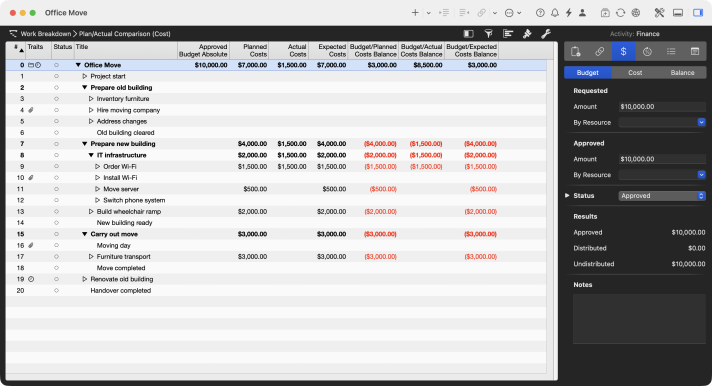
Plan and actuals against the contract
With T&M and a cap, the Budget/Expected Costs Balance shows at all times how much is left before the maximum. Under a fixed price, you see early as a contractor whether your margin is shrinking. Store the contract itself as a File attachment in the project. Try Merlin Project free for 30 days.
How to plan buying services from make-or-buy to contract award is covered in procurement management in projects. What makes up a project budget is explained in the glossary entry budget.
Sources
- Project Management Institute: A Guide to the Project Management Body of Knowledge (PMBOK Guide), 6th edition, chapter 12 Project Procurement Management, contract types
- Federal Acquisition Regulation (FAR), 16.601 Time-and-materials, 16.306 CPFF, 16.405-1 CPIF, 16.405-2 CPAF, 16.403-1 FPIF, 16.203-1 FP-EPA
- German Civil Code (BGB): § 611, § 631, § 640, § 641
If you have any questions about this blog article or would like to discuss it, we look forward to your contribution in our forum.
Frequently asked questions
What is the difference between time and materials and a fixed fee?
Under time and materials, the client pays the hours actually worked at fixed rates plus materials, so the client carries the cost risk. Under a fixed fee, the price for the agreed scope is set in advance, so the contractor carries the cost risk.
Which contract type should I use if the client wants cost predictability?
A firm fixed price (FFP) gives the most cost predictability because the contractor absorbs overruns. If the scope is still unclear, T&M with a cap gives predictability up to the maximum while the scope stays flexible.
What is the fixed capacity model, and how does it differ from fixed price?
Under a fixed capacity model, the client books a fixed team for a fixed period at a fixed price, for example per sprint. Scope stays flexible and the budget per period is fixed. Under a fixed price, the contractor owes a predefined total scope.
Is time and materials or fixed price better for software projects?
Time and materials suits software projects with changing requirements, because scope changes need no change request. A fixed price suits clearly specified work packages. You can also combine both: discovery on T&M, then the specified scope at a fixed price.
What is the difference between CPFF and CPIF?
Under CPFF, the contractor receives a fixed fee regardless of actual costs. Under CPIF, the fee falls to a minimum when costs exceed the target and rises to a maximum when they stay below it.
Can you mix time and materials and fixed price in one project?
Yes. Common options are a discovery phase on T&M followed by delivery at a fixed price, T&M with a cap, or a fixed price per milestone. State in the contract which work is billed under which model.