We are constantly on the lookout for skills from other fields that transfer to our own project work. So far that has been conductors in the orchestra pit, the animation studio Pixar, Sun Tzu's "The Art of War", the craft of storytelling and preparing for a marathon. This time it is a director who has delivered on time and on budget for 25 years.
Christopher Nolan was granted 100 shooting days for "The Odyssey". He wrapped on day 91, under budget, on a production that cost around 250 million dollars. On "Oppenheimer" he had already cut the schedule himself from 85 days to 57 in order to put the saved money into the sets of Los Alamos. He has worked like this for more than 25 years.
What Nolan says about it himself
This article is built on an interview in the Hollywood Reporter of 20 July 2026. Brian Davids asks how Nolan consistently comes in under budget and ahead of schedule despite the scale of his films. His answer explains the motive:
What I realized early on is that if I stayed on budget and on schedule, I got less interference. I didn't give people a reason to panic. That's when you find people breathing down your neck and questioning everything you're doing. If you can stay on the right side of that line, that buys you a different type of creative freedom.
Christopher Nolan, The Hollywood Reporter, 20 July 2026
What he does not supply is a method. In the same interview he makes clear that all filmmaking is a creative compromise and that he prefers to make those compromises on his own terms. Schedule and budget are part of those terms, because the decisions then sit in his hands. And he adds explicitly that not every filmmaker sees it that way, that this is completely valid, and that there is no right or wrong way to make a film.
Anyone hoping to derive a recipe from this will not find one. Every project brings its own compromises; the only question is who negotiates them. How Nolan puts himself in a position to negotiate them himself can be reconstructed from his documented way of working. That is what we do here.
Schedule discipline is a trade
Delay and overspend frighten whoever pays, and fear produces a desire for control. What follows is more reviews, more approval loops and more say in decisions that should sit with the team. Avoid the triggering signal and you keep the funder at arm's length and keep the authority to decide. Schedule discipline becomes the currency you pay for autonomy.
Two loops, one starting point
Both are self-reinforcing. Which one starts is decided at the first missed date.
Control loop
and the next date slips too
Trust loop
and the next date holds more easily
For projects outside Hollywood this is the most transferable part of the whole model. Deliver three milestones on time in a row and you have an argument in hand: longer reporting intervals and more decisions kept in the team. Few people ever open that negotiation, even though they have long since delivered the reliable performance it rests on.
The trade only works if the client actually releases autonomy once trust is there. In heavily regulated or politically charged environments, control happens regardless of delivery quality. There, schedule discipline buys calm but no additional room.
What the numbers support
Two schedules are documented with solid figures, and both support the claim. It still needs context, because Nolan negotiates his own budget. "Under budget" means under a frame he helped shape and that no studio would grant another director.
Shooting days: planned against actual
The two productions for which Nolan and producer Emma Thomas have given concrete numbers
Oppenheimer2023, around $100m
28 days fewer
The Odyssey2026, around $250m
9 days fewer
For the other films the schedules are only patchily recorded, while the budgets are well documented:
| Film | Year | Production budget | Shooting days |
|---|---|---|---|
| Following | 1998 | around $6,000 | weekends across about a year |
| Memento | 2000 | around $9m | not documented |
| Batman Begins | 2005 | around $150m | 129, no second unit |
| Inception | 2010 | around $160m | June to November, six countries |
| Dunkirk | 2017 | around $100m | 68, under budget and ahead of schedule |
| Tenet | 2020 | around $200m | 96 |
| Oppenheimer | 2023 | around $100m | 85 planned, 57 shot |
| The Odyssey | 2026 | around $250m | 100 planned, 91 shot |
John Leguizamo, who appears in "The Odyssey", described how that fits together to Variety: the budget is huge, but Nolan runs the shoot like an indie film because he does not decide by committee and does not go by what the studio says. The numbers come out of the way he works, not out of tight money.
The calculation worked out for the studio too. "The Odyssey" earned back its roughly $250 million production budget within its first days in cinemas and stood at $334.1 million after 13 days in North America alone, and over $700 million worldwide. In under two weeks the film therefore took more than "Oppenheimer" did across its entire North American run, which finished at around $330 million after 595 days. Industry projections put the film's final total well above one billion dollars. That bracket is otherwise reached almost exclusively by sequels and franchise titles. "The Odyssey" has neither a predecessor nor a cinematic universe behind it. If the projection holds, the film becomes Nolan's most successful, ahead of "The Dark Knight Rises" at around $1.08 billion.
The system behind it
The numbers prove the result, but not the route to it. From what Nolan and his crew have described over two decades, seven building blocks emerge that all do the same thing. They move uncertainty to where it is cheap. Whether they cause the schedule discipline or merely accompany it cannot be settled from a single case.
1. Resolve uncertainty before the expensive phase starts
Nolan works through the structure of a film long before anyone touches a camera. On the Scriptnotes podcast he describes setting the parameters and the structure first, working heavily with diagrams, and thinking like an editor while writing, because the effect comes from how images are juxtaposed. The writing is analogue; scenes sometimes end up on a legal pad in the middle of the night.
Producer Emma Thomas has described a fixed phase early in pre-production, known internally as "garage time", in a conversation with Deadline: a window for pure creativity, without a line producer, without a cinematographer, before logistics take over. That phase has been part of every project since "Batman Begins".
If you already have the cut in your head, you only shoot what you need and save the expensive cover shots.
In project management
Clarification costs almost nothing in the early phase and a multiple of that in execution. The relationship is known as the cost of change curve. Fixing a defect gets more expensive with every phase it goes undetected. Front loading therefore pulls analysis, requirements work and interface alignment forward deliberately, into the part of the project life cycle that sits before the first expensive activity. In practice that means settling the work breakdown structure and the assumptions while only thinking time is committed. Wherever execution is expensive, in construction, plant engineering, events or migrations, the same shift pays off. It is not the right route for every undertaking, though. In exploratory work with unclear requirements, early commitment is expensive, and agile short experiments beat any amount of upfront clarification.
2. A team you never have to brief
That preparation would be worthless if Nolan had to explain it to a new team on every film. Emma Thomas has produced virtually every one of his films since 1997. Casting director John Papsidera has been on board since "Memento", production designer Nathan Crowley since "Insomnia", joined over the years by cinematographer Hoyte van Hoytema, sound designer Richard King and SFX supervisor Scott Fisher. Coordination effort in a team like that is close to zero after two decades, because nobody has to explain how the work is done.
He still avoids going stale by deliberately recasting individual positions. Composer Ludwig Göransson, editor Jennifer Lame and production designer Ruth De Jong have joined in recent years, De Jong on "Oppenheimer" in a role Crowley had held across seven films.
In project management
Brooks's law describes the flip side. Adding people to a late project makes it later, because communication paths grow quadratically with team size and onboarding consumes the capacity of the experienced. A settled team saves that effort. The effect appears in no cost centre, which is why team stability regularly loses to short-term optimisation of utilisation, for instance when roles are recast again and again from a resource pool.
3. Run less in parallel
Only with a team that anticipates his intent can Nolan do so much himself. He does without second units and shoots every frame himself. On "Batman Begins" he personally oversaw every shot across all 129 days; he calls second units a very expensive luxury that rarely delivers usable material. Cinematographer Hoyte van Hoytema has described to Collider that there is usually only one camera on set, and that the whole department therefore evolves in one direction.
Less material means a faster cut, and fewer parallel strands mean fewer handover losses.
In project management
This is work-in-progress limiting as Lean and Kanban describe it. By Little's law, lead time depends directly on the amount of work open at once. Twice as many parallel strands means, at constant capacity, twice the lead time per strand, plus the setup cost of every context switch. If you do have to overlap activities, the clean techniques for that are under fast tracking, crashing and contouring. The limit of the analogy sits in the person. A single decision-making instance is always a bottleneck and a single point of failure.
4. Done means done, not "we'll fix it in post"
If you only shoot once, you have to get it right the first time. For "Tenet" Nolan bought a real Boeing 747 and drove it into a building after the calculation showed that this was cheaper than miniatures or CGI. The Trinity explosion in "Oppenheimer" was achieved practically in camera, built from a series of smaller detonations using gasoline, propane and aluminium powder and developed over months of tests. When shooting on film he has the dailies projected every evening, so everyone can see what is actually in the can.
That is a risk decision, not nostalgia. What is finished on set is costed and scheduled. That does not hold for post-production, where nobody knows effort, duration and cost in advance.
Where the risk goes
The same amount of work, two distributions of uncertainty
"Fix it in post"
"Get it right in camera"
In project management
Translated, that means signing work off where it is created rather than in a collection phase at the end. Every work package ticked off as "done except for" moves effort into a period where nobody has buffer left. A solid definition of done therefore separates "worked on" from "accepted", so that percent complete actually means accepted work. Without it, rework migrates into a phase that has no estimating basis, and the end date hangs on the least calculable stretch of the plan. The test before every handover is always the same: will the correction be cheaper or more expensive later? Where rework is expensive, sign-off at the source wins; where correction is cheap and requirements are unclear, iterating wins.
5. Scarcity as a control
Part of that discipline is enforced by the material itself. A 1,000-foot magazine for the IMAX camera runs out after roughly three minutes at 24 frames per second and has to be changed. For "The Odyssey" Nolan exposed around two million feet of film; at roughly $1.50 a foot that is around three million dollars for raw stock alone, about $1,500 per magazine.
On his debut "Following", film stock was the largest cost item and Nolan paid for it out of his own salary, so he rehearsed every scene until one or two takes were enough.
The constraint steers behaviour without anyone having to order it. If you know the magazine runs dry after three minutes, you block more precisely and rehearse more thoroughly. What that density means for the people involved was described by lead actor Matt Damon to the Hollywood Reporter: "The Odyssey" was by far the hardest shoot of his career.
In project management
Timeboxing in its purest form, and the practical answer to Parkinson's law: work expands to fill the time available. A fixed, tight window forces prioritisation at the point where it has to happen, which is before the work starts. Setting the duration of an activity deliberately shorter than the comfortable estimate is active time management rather than extrapolation. The limit is reached as soon as compression only works through extra hours and strain. From there it moves cost into the future instead of reducing it.
6. Decide without waiting for a committee
Planning that tightly is only possible if you decide fast enough. On "Oppenheimer" Nolan rebuilt the entire schedule himself once it was clear that the budget would not stretch to rebuilding Los Alamos. Production designer Ruth De Jong described the moment to Deadline: 85 planned shooting days became 57, and the freed-up money went into the sets and into locations previously cut as too expensive.
In project management
Decision latency is the biggest hidden time sink in most projects, because nobody books waiting time as effort. It shows up in no utilisation report, and yet the critical path stands still. Waiting is idle time, and idle time on the critical path pushes the end date out one for one, while on an activity with float it stays harmless. Unlike processing time it can be removed without additional resources, purely through clear decision rights, defined escalation paths and a decision maker who knows the state of play. Nolan's example names the condition too. A central decision maker without detailed knowledge only produces faster mistakes.
7. Defend thinking time against availability
Preparation of that kind needs uninterrupted time. Nolan uses no email and owns no smartphone, just a flip phone when travelling. His reasoning is that otherwise he loses the windows in which he stares out of the window and thinks about the next film. Cal Newport framed it in his analysis of the case as Nolan not asking whether email is useful, but whether it damages the thing he wants to be better at than anyone else.
He can only afford it because Emma Thomas and the production absorb the communication for him; casting offers go through her.
In project management
Bundling reactive channels into fixed blocks costs nobody a privilege, and the effect is measurable. Every switch between reactive communication and concentrated work costs ramp-up time until the state of play is back in your head. Anyone interrupted every fifteen minutes never reaches that state, which hits planning, risk management and estimating methods such as three-point estimation hardest, the activities whose quality determines how the project runs later. Protected blocks are therefore not a comfort but a quality assurance measure.
Best practices for project managers
Nolan's model cannot be copied as a whole, because part of it depends on his negotiating position. He helps shape budget and terms himself and decides neither by committee nor by studio instruction, as Leguizamo describes above. His operational principles, however, work without that position.
What transfers and what does not
Sorted by how much of Nolan's position each principle requires
Take
works in any organisation
Adapt
right at the core, with conditions
Leave
depends on his position or does harm
Translated from the film set into the project plan, four moves remain.
- Manage buffer centrally instead of scattering it across tasks. Nolan wrapped on day 91 of 100 and had nine days left over. Buffer hidden inside every single activity gets consumed without anyone noticing. A central project buffer stays visible.
- Set a baseline before you compress. Without a reference state you cannot say later whether the compression was real. The plan/actual comparison answers the question in one view.
- Only compress on the critical path. Every hour spent on an activity with float costs effort without moving the end date.
- Check utilisation before you believe the time saved. Two parallel bars are only genuinely parallel if two people can work on them. Utilisation shows whether the time gained is real or only looks good in the bar chart.
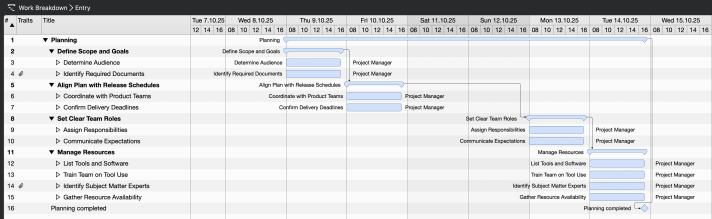
Professional project planning, all four moves in one view
Merlin Project brings buffer, baseline, critical path and utilisation together in one plan. You switch on the critical path via the lightning symbol, set the baseline before the first change, and read one view further to see what the compression does to the team. The app runs on Mac and iPad, offline too. Try it free for 30 days.
Conclusion
Nolan keeps schedules because he knows what he keeps them for. Schedule discipline is the currency he buys independence with, and that calculation works outside Hollywood too: deliver reliably and you get controlled less, and being controlled less lets you deliver more reliably.
Four principles remain, and they require nothing but consistency. Clarify early, while clarification still costs nothing. Work on less at the same time, so every strand runs through faster. Decide fast, because waiting time moves the end date exactly as working time does. And finish what you start, instead of carrying leftovers into a phase where nobody has buffer left.
How a very different profession answers the same question about leading without direct authority is in the article on what project managers can learn from conductors. And how a film studio organises creativity and deadline pressure together is what Ed Catmull describes in "Creativity, Inc.", covered in our review of what project managers can learn from Pixar.
If you have any questions about this blog article or would like to discuss it, we look forward to your contribution in our forum.
Frequently asked questions
How do you negotiate more autonomy as a project manager?
With delivered dates rather than with arguments. Once you have closed three milestones in a row on plan, you can propose concretely what should change in return: longer reporting intervals, a higher approval limit, or decisions that stay inside the team. The important part is making the proposal actively. Autonomy is rarely handed over on its own, even when delivery is sound.
Why does schedule slippage lead to more control so quickly?
A missed date signals to the client that their information base is wrong. The usual response is more status reviews and more approval loops. That cuts the time available for the actual work, which makes the next date more likely to slip. This control loop is self-reinforcing, which is why the first slip deserves to be taken more seriously than its size suggests.
What does front loading mean in project management?
Front loading deliberately moves clarification effort into the early phases, where only thinking time is committed and no expensive resources are running. Requirements, interfaces and acceptance criteria are settled before trades, machines or large teams start. The lever is the cost-of-change curve: the same correction costs a multiple in execution of what it would have cost in preparation.
How do you stop leftover work from sliding into the final project phase?
With a solid definition of done that separates "worked on" from "accepted", and with sign-off where the work is created. Every task ticked off as "done except for" moves effort into a period with no buffer and no estimating basis. The test before every handover: will the correction be cheaper or more expensive later?
Why is decision latency more dangerous than missing resources?
Because it appears in no utilisation report. Waiting for a decision is idle time, and idle time on the critical path pushes the end date out one for one. Unlike missing capacity it can be removed without additional budget: through clear decision rights, defined escalation paths and a decision maker who knows the state of play.
How much buffer belongs in a project plan, and where?
Not in every single activity, but pooled as a central project buffer at the end of the chain. Buffer hidden inside activities gets consumed under Parkinson's law without anyone noticing. A visible central buffer stays available as reserve and at the same time makes it measurable how much of it the project actually uses.
Which principles from Nolan's way of working transfer to ordinary projects?
Four transfer directly: pull clarification into the early, cheap phase, set deliberately tight timeboxes, keep decision paths short and protect focus time. Team stability, limiting parallel work and finishing at the source transfer with conditions. What does not transfer is his negotiating power and "under budget" as a measure of success, because he helps negotiate the budget frame himself.